
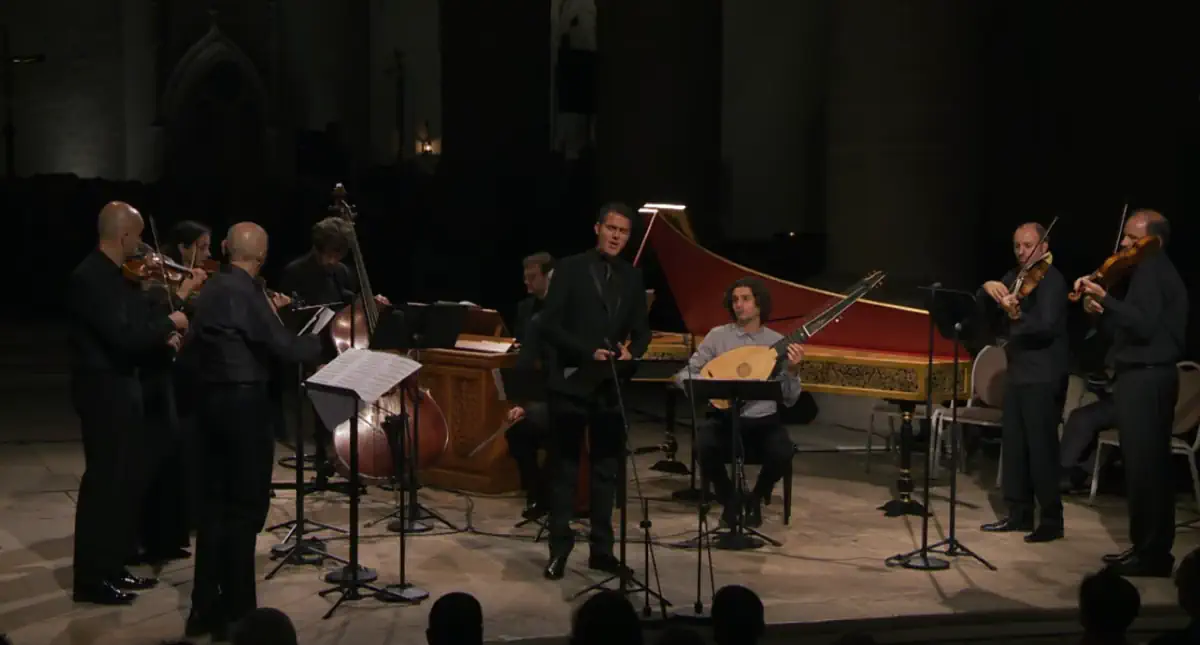
Accompanied by the Belgian instrumental ensemble Ricercar Consort, Spanish countertenor Carlos Mena performs Antonio Vivaldi’s “Nisi Dominus” for alto and orchestra, RV 608. Conductor: Philippe Pierlot.
Antonio Vivaldi – Nisi Dominus programme
- Nisi Dominus (Allegro)
- Vanum est vobis (Largo)
- Surgite (Presto)
- C. dederit (Andante)
- Sicut sagittae (Allegro)
- Beatus vir (Andante)
- Gloria Patri (Larghetto)
- Sicut erat in principio (Allegro)
- Amen (Allegro)
Antonio Vivaldi’s Nisi Dominus
Vivaldi’s Nisi Dominus, RV 608, is a setting of Psalm 126 in the Vulgate numbering, known as Psalm 127 in most modern English Bibles. It is a work of sacred vocal music intended for Vespers, the evening prayer service in the Catholic Church.
It is particularly interesting because, unlike many large-scale sacred works of the period, it is written for a single solo voice rather than a choir. The solo part can be performed by a contralto or a countertenor. The accompaniment consists of strings and basso continuo, with organ or harpsichord.
Vivaldi probably composed it between 1713 and 1717, during his association with the Ospedale della Pietà, the Venetian institution for orphaned and abandoned girls where he worked as a music teacher and composer. It was probably first performed there.
Structure and musical character
The work consists of nine movements, each setting a different part of the Psalm or its concluding doxology. It lasts roughly 15 to 20 minutes, depending on the performance.
What makes it especially fascinating is the variety of musical moods. Vivaldi doesn’t treat the text as a continuous, uniform prayer. Instead, he gives individual passages distinct musical characters, using changes in rhythm, tempo, melodic style, and instrumental color to reflect the meaning of the words.
Here are some of its most interesting movements:
- I. Nisi Dominus: The opening is energetic and rhythmically driven. Vivaldi uses a concerto-like orchestral introduction and a lively vocal line.
- II and III. Vanum est vobis: These movements contrast the futility of human effort with the idea of rest. The music changes character as the text develops.
- IV. Cum dederit: One of the most famous movements in the work. It is a slow, gently rocking movement, with a haunting, almost hypnotic atmosphere. The repeated rhythmic motion gives the music a quality of peaceful sleep.
- V. Sicut sagittae: The text compares children to arrows in the hands of a warrior. Vivaldi responds with a more animated musical character.
- VI. Beatus vir: Another energetic section, with a strong sense of forward movement.
- VII. Gloria Patri: Perhaps the most surprising movement. Instead of the expected triumphant celebration, Vivaldi writes slow, mournful music, featuring the distinctive sound of the viola d’amore.
- VIII. Sicut erat: Vivaldi returns to the musical material of the opening movement, creating a structural connection between the beginning and the end.
- IX. Amen: A lively and affirmative conclusion.

Sources
- Nisi Dominus (Vivaldi) on Wikipedia
