
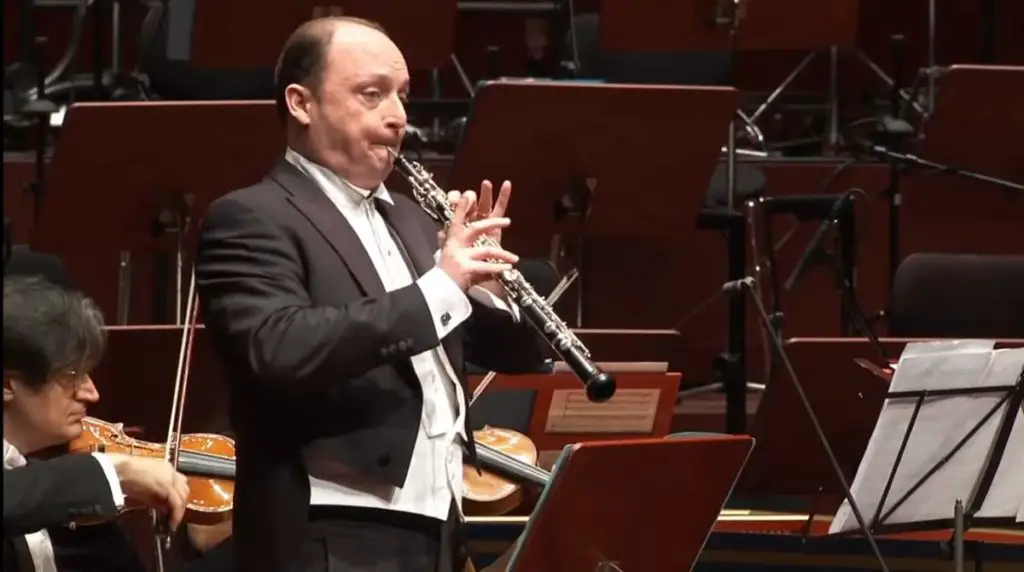
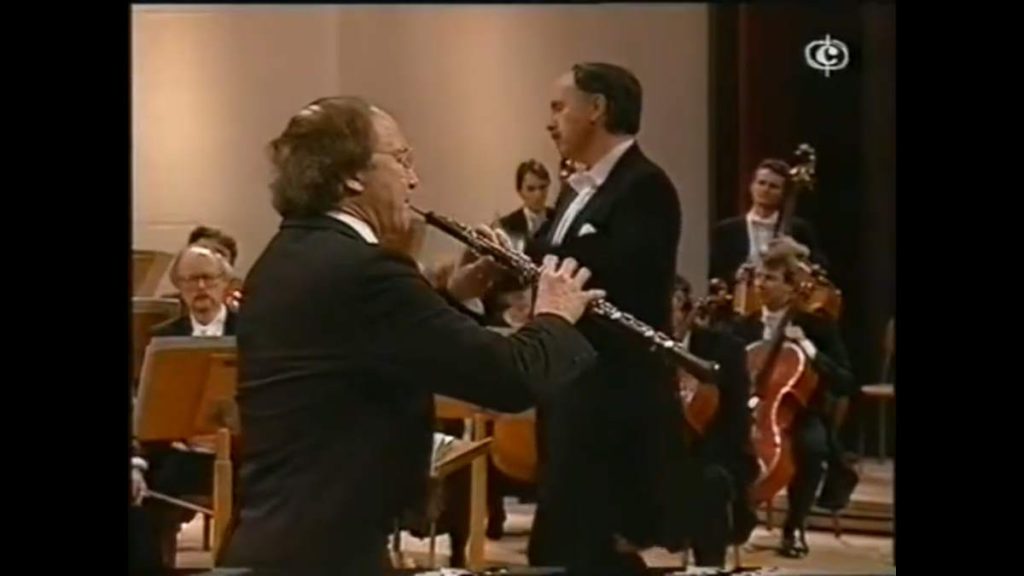
Accompanied by the Lausanne Chamber Orchestra, the Swiss virtuoso oboist Heinz Holliger performs Wolfgang Amadeus Mozart’s Oboe Concerto in C major, K. 314. Conductor: Jesus Lopez Cobos.
Mozart’s Oboe Concerto in C major, K. 314
Wolfgang Amadeus Mozart’s Oboe Concerto in C major, K. 314, was originally composed in Spring or Summer 1777 for oboist Giuseppe Ferlendis (1755-1802) from Bergamo, then reworked by the composer as a concerto for flute in D major in 1778. The concerto is a widely-studied piece for both instruments and is one of the more important concerti for the oboe.
Today, both versions are widely studied, but the oboe version is considered the original and more idiomatic form of the composition.
Historical Background and Rediscovery
For over a century, the oboe concerto was believed lost, while the flute version remained known and performed. This changed dramatically in 1920, when musicologist Bernhard Paumgartner discovered handwritten orchestral parts in the Salzburg Mozarteum archives.
Further analysis by Alfred Einstein confirmed that the concerto was originally written in C major for oboe, not flute. Musical evidence strongly supported this conclusion. The oboe’s lower range matched the original orchestration perfectly, while the flute version required adjustments and transposition into D major.
Interestingly, Mozart’s rearrangement was commissioned by Dutch flutist Ferdinand Dejean, but Dejean refused to pay Mozart for this concerto because it was based on an earlier oboe work.
Instrumentation and Structure
The concerto uses a classical orchestra typical of Mozart’s Salzburg works:
- Solo oboe
- Strings, violin I and II, viola, cello, and double bass
- Two oboes
- Two horns
The work follows the standard Classical concerto form in three movements, balancing virtuosity with lyrical beauty.
Movements:
- Allegro aperto, C major: This energetic opening presents bright themes, elegant orchestral dialogue, and brilliant solo passages demonstrating oboe agility and expressive clarity.
- Adagio non troppo, F major: This slow movement offers lyrical serenity, expressive phrasing, emotional depth, and delicate orchestral accompaniment supporting the oboe’s singing tone.
- Rondo: Allegretto, C major: This lively finale features playful recurring themes, rhythmic vitality, virtuosic flourishes, and joyful exchanges between soloist and orchestra.
Musical Importance
Mozart’s Oboe Concerto is widely regarded as one of the finest oboe concertos ever written. It demonstrates:
- Perfect balance between soloist and orchestra
- Elegant Classical structure
- Exceptional melodic invention
- Deep understanding of the oboe’s expressive capabilities
The concerto remains a core piece in professional oboe training and performance worldwide.
Mozart’s ability to successfully adapt the concerto for flute also shows his extraordinary skill in tailoring music to specific instruments.
Surviving Manuscripts
No complete original autograph score survives. Only a small fragment of nine measures was discovered in 1971. However, surviving orchestral parts have allowed scholars to reconstruct the original concerto with high confidence.
Heinz Holliger
Heinz Robert Holliger, born May 21, 1939, in Langenthal, Switzerland, is widely regarded as one of the greatest oboists of the twentieth and twenty first centuries. Renowned for his extraordinary technical precision, expressive range, and intellectual depth, Holliger has shaped modern oboe performance and expanded its repertoire significantly. His musical activities extend beyond performance to composition and conducting, making him one of the most versatile figures in contemporary classical music.
Holliger began studying the oboe at age eleven and quickly demonstrated exceptional talent. He studied at the Bern Conservatory and achieved international recognition by winning first prize in oboe at the Geneva International Music Competition in 1959. In 1966, he began teaching at the Hochschule für Musik Freiburg, influencing a new generation of musicians. His performances cover a wide range of music, from Baroque and Classical masterpieces to modern and experimental works. His interpretations helped revive interest in lesser known composers, including Jan Dismas Zelenka, whose trio sonatas gained renewed attention after Holliger’s influential 1972 recording.
Composer and Collaborator
Holliger studied composition with Sándor Veress and Pierre Boulez, two major twentieth century composers, which strongly influenced his compositional style. He has written numerous works across many genres, including orchestral, chamber, vocal, and operatic compositions. His opera Schneewittchen, premiered in 1998, is among his most notable works. His music often combines emotional intensity with complex modern techniques and literary influences, including poetry by Georg Trakl and Friedrich Hölderlin.
Many leading composers wrote works specifically for Holliger, including Olivier Messiaen, Luciano Berio, Elliott Carter, Krzysztof Penderecki, Karlheinz Stockhausen, and Witold Lutosławski. His collaborations, often with his wife, harpist Ursula Holliger, helped promote contemporary music worldwide.
Recognition and Legacy
Holliger has received numerous prestigious awards, including the Ernst von Siemens Music Prize, the Léonie Sonning Music Prize, and the Robert Schumann Prize. His career has had a profound impact on both oboe performance and contemporary classical composition, establishing him as one of the most influential musicians of his era.
Sources
- Oboe Concerto (Mozart) on Wikipedia
- Heinz Holliger on Wikipedia
