
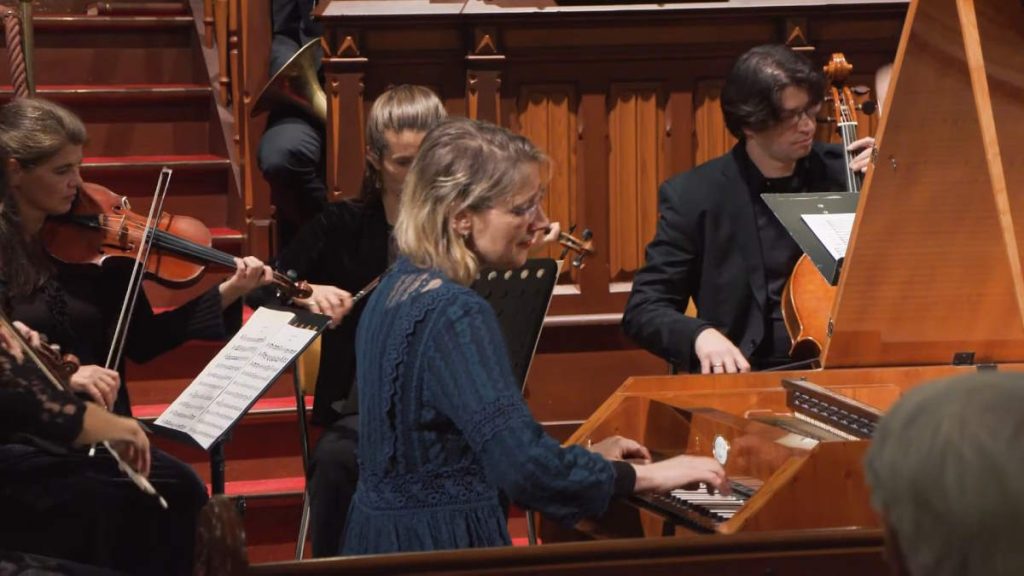
Accompanied by the Hofkapelle München, the Belgian pianist Els Biesemans performs Wolfgang Amadeus Mozart’s Piano Concerto No. 24 in C minor, K. 491, on fortepiano, Mozart’s original instrument. This performance was recorded on November 13, 2022, at the Bühlkirche Zurich.
Mozart’s Piano Concerto No. 24
Mozart’s Piano Concerto No. 24 in C minor, K. 491, is one of the most powerful and unusual works in his concerto output. He composed it during the winter of 1785 to 1786 and completed it on 24 March 1786, only a few weeks after finishing his Piano Concerto No. 23 in A major. The concerto was probably first performed in early April 1786 at the Burgtheater in Vienna, with Mozart himself as soloist and conductor from the keyboard.
This concerto stands apart for several reasons. It is one of only two piano concertos by Mozart in a minor key, the other being the famous Piano Concerto No. 20 in D minor. It also uses the largest orchestra of any of his piano concertos, including strings, flute, oboes, clarinets, bassoons, horns, trumpets, timpani, and solo keyboard. The inclusion of both oboes and clarinets gives the work an especially rich wind sound. In many passages, the wind instruments do not simply support the strings; they take on a central expressive role.
The concerto was written close to the time of The Marriage of Figaro, yet its emotional world is very different from that comic opera. While Figaro is mostly bright, witty, and theatrical, the concerto is dark, tense, and serious. Scholars have often seen it as an outlet for Mozart’s more dramatic and troubled imagination. The original manuscript also shows signs of haste. The orchestral writing is mostly complete, but the piano part is sometimes sketchy, suggesting that Mozart expected to improvise parts of it himself during performance.
The work has three movements: Allegro, Larghetto, and Allegretto. Together, they form one of Mozart’s most integrated and dramatic concerto structures. Later musicians admired it deeply. Beethoven, Brahms, Clara Schumann, and many musicologists considered it one of Mozart’s greatest achievements in the concerto form.
Movements
There are three movements. With start times in the video:
- 0:00 Allegro
- 14:18 Larghetto
- 21:33 Allegro
I. Allegro
The first movement, Allegro, is in C minor and is the longest and most complex opening movement Mozart had written for a piano concerto up to that point. It is in sonata form, but Mozart treats that form with unusual freedom. The movement begins not with a heroic loud statement, but with the orchestra playing the principal theme softly and in unison. This is immediately striking. Instead of asserting power, the music sounds tense, mysterious, and unstable. The theme is also highly chromatic, using all twelve notes of the chromatic scale within its opening span. This gives the music a restless, searching quality.
The orchestral exposition presents the main material, but Mozart does not use the usual concerto pattern in a simple way. When the piano finally enters, it does not simply repeat the main theme. Instead, it begins with an eighteen-measure solo passage of its own. Only after that does the principal theme return in the orchestra, with the piano joining later. This already makes the relationship between soloist and orchestra more dramatic and less predictable than in many Classical concertos.
The solo exposition also introduces new secondary material rather than merely repeating what the orchestra has already played. This was seen by Donald Tovey as a bold challenge to the usual idea that the opening orchestral section should predict what the soloist will later say. Mozart creates almost a double exposition, extending the structure and making the movement feel unusually broad.
The development section intensifies the drama. The piano recalls its earlier entrance, now in E flat major, but the music soon moves into darker territory. The main theme is fragmented and developed, with the piano and orchestra engaging in stormy exchanges. Writers such as Cuthbert Girdlestone and Tovey emphasized the passion and severity of this section. It is one of those moments in Mozart where the emotional tension feels unusually exposed and forceful.
In the recapitulation, Mozart must bring back a large amount of thematic material. He does so in compressed form, mostly in C minor. The movement leads to a cadenza, but Mozart did not leave one written out. Later musicians, including Brahms, Busoni, Schnittke, and Fauré, wrote cadenzas for it. The ending is also unusual. Instead of the soloist disappearing before the final orchestral close, the piano interrupts and continues to accompany the orchestra almost to the final quiet C minor chords. The result is dramatic, shadowed, and unresolved in feeling, even at its close.
II. Larghetto
The second movement, Larghetto, is in E flat major, the relative major of C minor. After the dark and complex first movement, this music offers calm and simplicity. Alfred Einstein described it as moving in a world of pure and deeply touching tranquility. Its beauty lies not in complexity but in restraint. The trumpets and timpani are silent here, which softens the orchestral color and creates a more intimate atmosphere.
The movement begins with the piano alone, playing a four-measure principal theme. This theme is extremely simple, almost childlike. It avoids ornament and drama. The orchestra then repeats it. This simplicity is important because it creates a strong contrast with the first movement’s chromatic intensity. Mozart had apparently sketched a more complex version of the theme at first, but he simplified it, probably to make the movement feel more innocent and transparent.
The structure is basically rondo-like, often summarized as ABACA. The main theme returns several times, separated by contrasting episodes. After the first statement and a short bridge, the piano repeats the opening theme. Then the music moves into a C minor section, which gently reminds the listener of the darker world of the first movement. This does not destroy the calm mood, but it adds emotional depth. A later section in A flat major brings another contrast, warmer and more expansive.
One of the interesting features of this movement is that some of its simple transitional passages may have been intended for ornamentation by the performer. Girdlestone argued that playing them exactly as printed would not reflect Mozart’s likely intention, because Mozart himself probably would have decorated them in performance. This reminds us that eighteenth-century performance practice was more flexible than modern printed scores sometimes suggest.
The movement also contains a possible notational error. In one passage, a literal reading of the score creates a harmonic clash between the piano and winds. Some performers and scholars, including Alfred Brendel, believe the passage should be corrected rather than played exactly as written. Brendel also thought the time signature might be misleading, because playing it strictly in cut common time could make the movement too fast.
Despite these technical issues, the Larghetto is one of Mozart’s most serene concerto movements. It is not merely a peaceful pause between two darker movements. Rather, it shows another side of the concerto’s emotional world, tender, simple, inward, and deeply human.
III. Allegretto
The finale of Mozart’s Piano Concerto No. 24, Allegretto, returns to C minor and takes the form of a theme with eight variations. Arthur Hutchings considered it both Mozart’s finest use of variation form and his greatest concerto finale. Instead of ending with a brilliant, carefree rondo, as many Classical concertos do, Mozart closes the work with a movement that remains serious, controlled, and darkly energetic.
The theme is first played by the violins, with accompaniment from strings and winds. It consists of two eight-measure phrases, each repeated. The first phrase moves from C minor toward G minor, while the second returns to C minor. The piano does not take part in the opening statement of the theme. This is significant. The soloist enters only in the first variation, where the piano begins to decorate the theme over a severe string accompaniment. From the beginning, the movement is more austere than showy.
Variations two through six are described by some scholars as “double” variations. This means that each repeated phrase is varied again when it returns. Mozart therefore creates a highly organized structure, but within that structure, he allows many changes of mood and texture. Some variations remain in C minor and preserve the tragic or tense quality of the movement. Others move into major keys. Variation four, in A flat major, has been described as cheerful, while variation six, in C major, has been called graceful. These major key moments bring light into the movement, but they do not completely erase its darker character.
Variation five returns to C minor and is especially moving. Variation seven is shorter than the others because it omits the repeated halves of the theme. It ends with an added passage that leads to a dominant chord and prepares the cadenza. After the cadenza, the eighth and final variation begins with the solo piano alone. The meter then changes from cut common time to compound duple time, giving the ending a new rhythmic character.
The final variation and coda contain many Neapolitan sixth chords, which give the music a haunting color. Girdlestone described their effect as deeply unsettling. Unlike many concerto finales, this one does not simply celebrate victory. Instead, the coda seems to insist on the triumph of the minor mode. The concerto ends not in easy brightness, but in dramatic seriousness. This makes the finale feel like the true conclusion of the whole work, not merely a display piece for the soloist.
Critical importance and legacy
Mozart’s Piano Concerto No. 24 was admired by some of the greatest musicians who came after him. Beethoven knew the work and is said to have remarked that later composers would never be able to do anything like it. It may also have influenced Beethoven’s own Piano Concerto No. 3, which is likewise in C minor. Brahms admired the concerto so much that he encouraged Clara Schumann to play it and wrote his own cadenza for the first movement.
Modern scholars have often placed K. 491 among Mozart’s greatest works. Cuthbert Girdlestone considered it one of Mozart’s greatest concertos, perhaps the greatest, though he admitted that choosing among Mozart’s finest concertos is difficult. Alfred Einstein emphasized its dark, tragic, and passionate character. Simon P. Keefe described it as a culminating work in Mozart’s piano concerto output, connected to earlier concertos but also going beyond them. Alexander Hyatt King called it not only the most sublime of Mozart’s concertos but one of the greatest piano concertos ever written.
What makes the concerto so extraordinary is its unity. The three movements are different in mood, but they belong together. The first movement is dramatic and complex, the second is calm and pure, and the third is severe and tragic in its variation form. The large orchestra, especially the rich wind writing, gives the work unusual color and depth. The piano is not merely a brilliant solo instrument; it is part of an intense conversation with the orchestra.
In the end, K. 491 shows Mozart at his most advanced in the concerto genre. It combines formal mastery, emotional depth, orchestral richness, and daring structural choices. It is not just a beautiful concerto, but a profound and dramatic musical argument.
Els Biesemans
Els Biesemans, born in 1978 in Antwerp, Belgium, is a Belgian organist and pianist based in Zurich. She is known for her wide musical range, performing on organ, fortepiano, clavichord, harpsichord, Romantic piano, and modern piano. Her work is strongly connected with historical performance practice, and her organ repertoire extends from music of the late Middle Ages to contemporary works.
Biesemans studied piano with Alan Weiss and Jan Vermeulen, organ with Reitze Smits, and chamber music at the LUCA School of Arts in Leuven, Belgium. She completed her studies with a Master of Music and received the highest distinctions in both organ and piano. Afterward, she continued her training at the Schola Cantorum Basiliensis in Basel, one of Europe’s leading institutions for early music. There, she studied fortepiano with Jesper Christensen and organ with Andrea Marcon and Wolfgang Zerer.
As a performer, Biesemans has built an international career. She has appeared as a soloist across Europe, Japan, Canada, and the United States. In 2006 and 2007, she performed the complete organ works of Johann Sebastian Bach in a series of 19 concerts in Zurich, a major artistic project that demonstrated both her technical command and deep engagement with Bach’s music.
She has held several important organist positions. From 2002 to 2006, she was titular organist of the Van Bever organ at the Church of the Dominicans in Brussels. From 2006 to 2009, she served as organist at the Church of Maria Krönung in Zurich-Witikon. Since May 2010, she has been titular organist at the Reformed Church of Bühl in Zurich-Wiedikon. Since the same year, she has also been artistic director of Musik in der Bühlkirche and the Zurich Hammerklavier Festival.
Alongside her organ career, Biesemans is active as a fortepianist and chamber musician. She has performed as a soloist in major venues including the Philharmonie Berlin, Philharmonie Essen, Tonhalle Zurich, and the Philharmonique Royal Liège. Her festival appearances include the Montréal Bach Festival, Leipzig Bach Festival, Bremen Music Festival, Festival van Vlaanderen, BOZAR Music Brussels, Forum Alte Musik Zürich, Toulouse-les-Orgues, and the Boston Clavichord Society in the United States. She has also made recordings for French, Belgian, and Swiss radio.
Biesemans has received numerous awards in international competitions. She won the International Organ Competition in Vilnius and the Arp Schnitger Organ Competition in Bremen. She has also received prizes at major competitions in Nijmegen, Bruges, Graz, Tokyo, Paris, Leipzig, and Montréal, including the Bach Prize at the Canadian International Organ Competition.
Sources
- Piano Concerto No. 24 (Mozart) on Wikipedia
- Els Biesemans on Wikipedia
- Piano Concerto No. 24 in C minor, K.491 (Mozart, Wolfgang Amadeus) on the International Music Score Library Project website
- Mozart’s Piano Concerto No. 24 in C minor, K. 491, on the L.A. Phil website
