
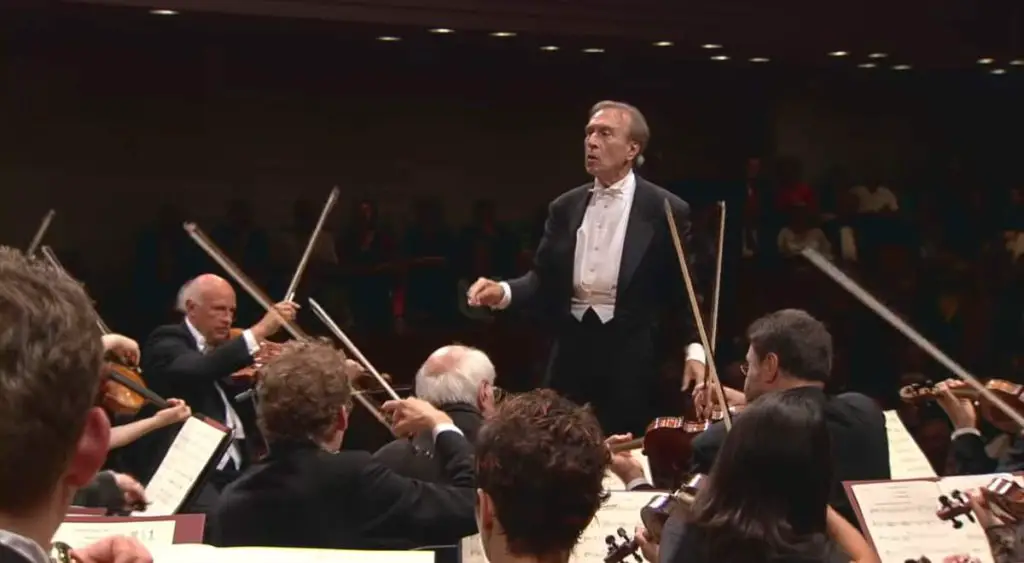
Conducted by Claudio Abbado, the Lucerne Festival Orchestra performs Gustav Mahler’s Symphony No. 5. Recorded in 2004.
Gustav Mahler’s Symphony No. 5
The symphony was composed in 1901 and 1902, mostly during the summer months at Mahler’s cottage at Maiernigg, a municipality in the district of Klagenfurt-Land in the Austrian state of Carinthia. Among its most distinctive features is the trumpet solo that opens the work and the frequently performed Adagietto.
The musical canvas and emotional scope of the work, which lasts over an hour, are huge. The symphony is sometimes described as being in the key of C# minor since the first movement is in this key (the finale, however, is in D). Mahler objected to the label: “From the order of the movements (where the usual first movement now comes second) it is difficult to speak of a key for the ‘whole Symphony’, and to avoid misunderstandings the key should best be omitted.”
Movements
The work is in five movements:
- Trauermarsch (Funeral March). In gemessenem Schritt. Streng. Wie ein Kondukt (C-sharp minor)
- Stürmisch bewegt, mit größter Vehemenz (Moving stormily, with the greatest vehemence) (A minor)
- Scherzo. Kräftig, nicht zu schnell (Not too fast, strong) (D major)
- Adagietto. Sehr langsam (Very slow) (F major)
- Rondo-Finale. Allegro – Allegro giocoso. Frisch (Fresh) (D major)

1. Trauermarsch (Funeral March). In gemessenem Schritt. Streng. Wie ein Kondukt (C-sharp minor)
The first movement of Gustav Mahler’s Symphony No. 5 opens with one of the most famous trumpet calls in all symphonic music, stark, ceremonial, and unsettling. From the beginning, Mahler places us in a world of grief, but this is not quiet resignation. The funeral march has dignity and control, yet beneath it, you can hear tension, fear, and emotional instability.
The tread of the procession keeps returning, as if sorrow cannot be escaped. Mahler contrasts public mourning with deeply personal anguish, moving between stern, almost military rhythms and passages of fragile lyricism. The result is both dramatic and psychological. This is not simply music about death; it is music about how the living experience shock, memory, and emotional fracture after loss.
2. Stürmisch bewegt, mit größter Vehemenz (Moving stormily, with the greatest vehemence) (A minor)
The second movement erupts almost immediately out of the emotional world of the first, but now grief becomes a violent struggle. This is one of the most turbulent things Mahler ever wrote. The music seems to fight itself, pushing forward with explosive energy, sudden collapses, jagged rhythms, and fierce orchestral outbursts. It can sound chaotic, but it is carefully shaped chaos.
Mahler turns the funeral atmosphere into an inner battle, as if mourning has become rage, desperation, and resistance. At times, brighter and more hopeful ideas appear, but they are not yet secure. They are interrupted, challenged, and nearly overwhelmed. The movement feels like an attempt to climb out of darkness, but without certainty that escape is possible. It is emotionally exhausting and intentionally so.
3. Scherzo. Kräftig, nicht zu schnell (Not too fast, strong) (D major)
The Scherzo is the symphony’s giant turning point. After the darkness of the opening movements, Mahler suddenly gives us music that feels expansive, earthy, rhythmic, and full of motion. This is not simple happiness, though. The movement is huge, complex, and unpredictable, with a constantly shifting character. Rustic dance rhythms, especially Ländler-like Austrian folk dance patterns, mix with brilliant orchestral writing and an important solo horn part.
At times the music sounds exuberant and life-affirming, at other times ironic, unstable, or dreamlike. Mahler seems to be rebuilding the world from fragments. The movement stands almost like the symphony’s center of gravity, where despair begins to loosen its grip and energy returns. But this new vitality is complicated, human, and full of contradictions.
4. Adagietto. Sehr langsam (Very slow) (F major)
The Adagietto is the most famous movement of the symphony, often performed on its own. Scored only for strings and harp, it creates an intimate sound world completely different from the massive orchestral forces around it. It is often heard as a love song, and many writers connect it with Mahler’s feelings for Alma. The music unfolds slowly, tenderly, and with extraordinary patience.
There is sadness in it, but not the crushing grief of the first movement. Instead, the emotion feels inward, suspended, vulnerable, and deeply lyrical. Mahler avoids grand gestures, letting the line breathe and expand naturally. Because of its beauty and stillness, the movement has often been used in memorial contexts, but in the symphony, it also serves as a moment of emotional purification before the final release.
5. Rondo-Finale. Allegro – Allegro giocoso. Frisch (Fresh) (D major)
The finale of Mahler’s Symphony No. 5 brings the work to a completely different emotional horizon. After the stillness of the Adagietto, Mahler launches into a movement full of energy, wit, contrapuntal skill, and forward momentum. This is not a shallow happy ending. Rather, it feels earned because it grows out of everything that came before.
Themes are developed, transformed, and woven together with astonishing craftsmanship. You can hear Mahler’s delight in complexity, but also his desire for affirmation. The music dances, argues, laughs, and finally triumphs. Where the symphony began with a funeral march in C sharp minor, it ends in a bright D major world that seems open and liberated. The finale suggests not innocence, but renewal, as if life has survived suffering and discovered joy again through struggle.
Sources
- Symphony No. 5 (Mahler) on Wikipedia
- “Symphony No. 5 in C-Sharp Minor, musical composition by Mahler” on the Encyclopedia Britannica website
- Symphony No. 5, GMW 44 (Mahler, Gustav) on the International Music Score Library Project website
- Symphony No. 5 on the Mahler Foundation’s website
