
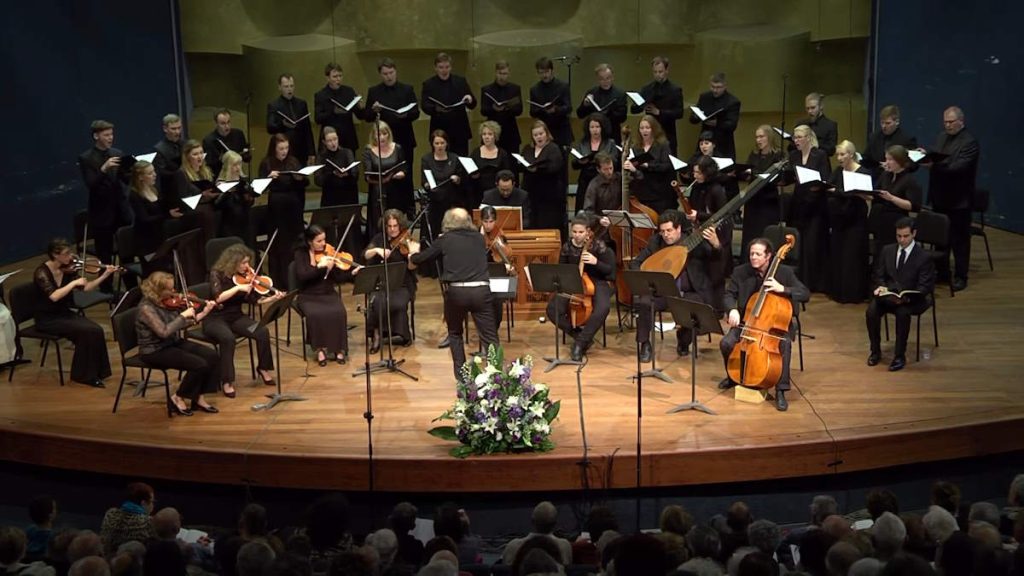
Conducted by Sir John Eliot Gardiner, the Monteverdi Choir and the English Baroque Soloists perform Georg Friedrich Händel’s psalm setting Dixit Dominus (cataloged as HWV 232). The work uses the Latin text of Psalm 110 (Vulgate 109), which begins with the words Dixit Dominus (“The Lord Said”). This performance was recorded on June 22, 2014.
Soloists: Miriam Allan (soprano), Esther Brazil (soprano), Katy Hill (soprano), Emilia Morton (soprano), Emma Walshe (soprano), Rory McCleery (alto), Ben Alden (tenor), Sean Clayton (tenor), Peter Harris (tenor), Alexander Ashworth (bass), and Rupert Reid (bass).
Georg Friedrich Händel’s Dixit Dominus (HWV 232)
Georg Friedrich Händel’s Dixit Dominus (HWV 232) is one of the most astonishing works of his early career-and one of the most powerful sacred compositions of the Baroque era.
Händel wrote Dixit Dominus in 1707, when he was only 22 years old, during his stay in Italy. At that time, Italy was the center of European music, especially for opera and sacred vocal writing. Young Händel absorbed the Italian style at full speed, and Dixit Dominus shows a composer already in complete command of counterpoint, drama, and vocal virtuosity.
The text comes from Psalm 110 (Vulgate numbering), beginning with the words “Dixit Dominus Domino meo” (“The Lord said unto my Lord”). This psalm is intense, martial, and authoritative, full of images of power, judgment, and divine rule. Händel responds with music that is bold, relentless, and almost ferocious.
The work is written for a five-part choir (SSATB), soloists, string orchestra, and continuo. From the opening movement, the listener is struck by the driving rhythmic energy and dense choral counterpoint. Voices enter one after another in tight imitation, creating a sense of unstoppable momentum. This is not calm church music-it feels urgent, dramatic, and even combative.
One of the most famous sections is “Juravit Dominus”, a slow movement where Händel suddenly shifts the mood. Here, long lines and suspensions create a feeling of solemn oath and timeless authority. The contrast between explosive fast movements and deeply expressive slow ones shows Händel’s instinct for large-scale structure, even at such a young age.
Another striking movement is “De torrente in via bibet,” where the music briefly relaxes before rushing forward again. Händel constantly plays with tension and release, never allowing the listener to settle for long.
What makes Dixit Dominus remarkable is not just its technical brilliance, but its emotional intensity. Händel treats the sacred text with the same dramatic force he would later bring to opera and oratorio. In many ways, this work already points toward the Messiah, written decades later.
Today, Dixit Dominus is considered one of Händel’s greatest choral works and a cornerstone of the Baroque repertoire. It remains challenging for choirs and thrilling for listeners-a clear declaration that Händel was a master from the very beginning.
Dixit Dominus: Movements and Texts
1. Chorus
The Lord said unto my Lord:
Sit thou on my right hand, until I make thine enemies thy footstool.
Dixit Dominus Domino meo:
Sede a dextris meis, donec ponam inimicos tuos scabellum pedum tuorum.
2. Aria
(alto solo) The Lord shall send the rod of thy power out of Sion:
Be thou ruler, even in the midst among thine enemies.
Virgam virtutis tuae emittet Dominus ex Sion:
dominare in medio inimicorum tuorum.
3. Aria
(soprano solo) In the day of thy power, shall the people offer thee free will offerings with holy worship.
From the womb before the morning star have I begotten thee.
Tecum principium in die virtutis tuae splendoribus sanctorum.
Ex utero ante luciferum genui te.
4. Chorus
The Lord swore, and will not repent:
Juravit Dominus et non poenitebit eum:
5. Chorus
Thou art a priest forever after the order of Melchisedech.
Tu es sacerdos in aeternum secundum ordinem Melchisedech.
6. Soloists and chorus
The Lord upon thy right hand,
shall wound even kings in the day of his wrath.
Dominus a dextris tuis,
confregit in die irae suae reges.
7. Chorus
He shall judge the nations,
fill the places with destruction, and shatter the skulls in the land of the many.
Judicabit in nationibus,
Implebit ruinas, conquassabit capita in terra multorum.
8. Soprano duet and chorus
He shall drink of the brook in the way,
Therefore, shall he lift up his head?
De torrente in via bibet,
Propterea exaltabit caput.
9. Chorus
Glory be to the Father, and to the Son, and to the Holy Spirit.
As it was in the beginning, is now; and ever shall be, a world without end. Amen.
Gloria Patri, et Filio, et Spiritui Sancto,
Sicut erat in principio, et nunc, et semper, et in saecula saeculorum. Amen.
Sources
- George Frideric HANDEL: Dixit Dominus, HWV 232 on the L.A. Phil website
- Dixit Dominus (Handel) on Wikipedia
- “Watch an analysis of Handel’s Dixit Dominus” on the BBC Radio 3 website
