
Conducted by Jos van Veldhoven, the Netherlands Bach Society performs Johann Sebastian Bach’s “Mass in B minor, BWV 232”, a musical setting of the complete Ordinary of the Latin Mass. This performance was recorded for the Netherlands Bach Society’s project All of Bach on December 15, 2016, at the Grote Kerk, Naarden.
Performers
- Netherlands Bach Society
- Jos van Veldhoven, conductor
- Hana Blažíková, soprano 1
- Anna Reinhold, soprano 2
- David Erler, alto
- Thomas Hobbs, tenor
- Peter Harvey, bass
Program
With start times in the video:
- 0:00 Kyrie eleison (Choir)
- 11:07 Christe eleison (Duet)
- 15:56 Kyrie eleison (Choir)
- 19:43 Gloria in excelsis Deo (Choir)
- 21:25 Et in terra pax (Choir)
- 26:07 Laudamus te (Aria)
- 30:10 Gratias agimus tibi (Choir)
- 33:19 Domine Deus (Duet)
- 38:39 Qui tollis (Choir)
- 41:39 Qui sedes (Aria)
- 45:50 Quoniam tu solus sanctus (Aria)
- 50:33 Cum Sancto Spiritu (Choir)
- 54:15 Credo in unum Deum (Choir)
- 56:14 Patrem omnipotentem (Choir)
- 58:15 Et in enum Dominim (Duet)
- 1:02:38 Et incarnatus est (Choir)
- 1:05:52 Crucifixus (Choir)
- 1:08:58 Et resurrecit (Choir)
- 1:12:57 Et in Spiritum Sanctum (Aria)
- 1:18:13 Confiteor (Choir)
- 1:22:18 Et expecto (Choir)
- 1:24:31 Sanctus (Choir)
- 1:26:59 Pleni sunt caeli
- 1:29:20 Osanna in exelsis (Choir)
- 1:32:00 Benedictus qui venit (Aria)
- 1:36:23 Osanno in excelsis (Choir)
- 1:39:06 Agnus Dei (Aria)
- 1:45:19 Dona nobis pacem (Choir)
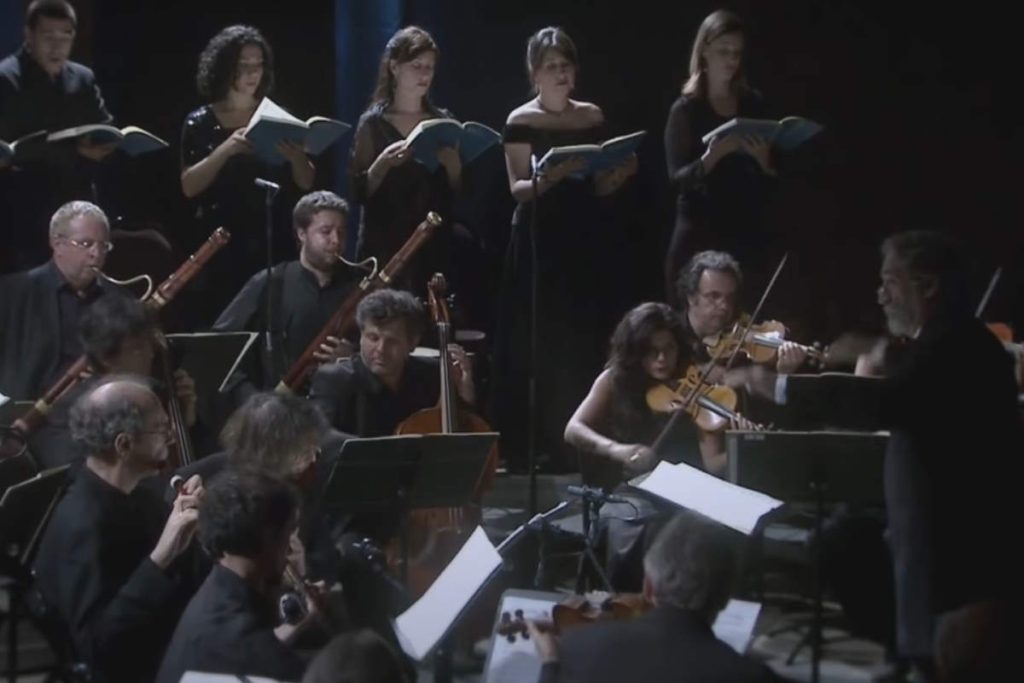
Johann Sebastian Bach’s Mass in B minor, BWV 232
The Mass in B minor, BWV 232, by Johann Sebastian Bach, is widely regarded as one of the greatest achievements in Western music. Completed in 1749, the year before Bach’s death, the work represents not a single unified composition written at once, but rather a carefully assembled synthesis of music spanning decades of his career.
A Work Built Over Time
The Mass in B minor was constructed gradually. Some of its material dates back to earlier compositions, including a Sanctus written in 1724, while the Kyrie and Gloria were composed in 1733 as a standalone Missa. Later, in the final years of his life, Bach expanded this material into a complete setting of the Latin Mass by composing or adapting additional sections, including parts of the Credo such as the “Et incarnatus est.”
This layered origin gives the Mass a unique character. It is not merely a liturgical work but a retrospective compilation, bringing together some of Bach’s finest vocal writing into a monumental whole.
Structure and Scale
The Mass follows the traditional structure of the Catholic Mass Ordinary and is organized into four major sections:
- Kyrie and Gloria
- Credo (Symbolum Nicenum)
- Sanctus
- Osanna, Benedictus, Agnus Dei, and Dona nobis pacem
Bach himself grouped these into separate folders, suggesting that each section could function independently.
The work is vast in scope, typically lasting around two hours. It is scored for:
- five vocal soloists
- a five-part choir, sometimes divided into double choir
- a full Baroque orchestra including strings, continuo, winds, brass, and timpani
This large scale, combined with its structural complexity, makes the Mass one of the most ambitious choral works ever written.
A Rare “Missa tota”
For a Lutheran composer, Bach’s decision to set the entire Catholic Mass is highly unusual. In his time, Lutheran services typically required only the Kyrie and Gloria. Bach had written several such shorter masses earlier in his career, but the Mass in B minor is a Missa tota, a complete setting of the Latin Ordinary.
This suggests that the work was not intended for regular liturgical use, but rather for a broader artistic or ceremonial purpose.
Historical Context
The origins of the Mass are partly tied to Bach’s professional ambitions. In 1733, following the death of Augustus II, Bach composed the Kyrie and Gloria and presented them to the new ruler, Augustus III, hoping to secure a court position. His efforts eventually succeeded, and he was appointed court composer in 1736.
The later expansion of the Mass remains more mysterious. Scholars have proposed several possibilities:
a performance at the Dresden court or its new cathedral
a planned presentation in Vienna
or a purely artistic project, similar to The Art of Fugue, intended as a comprehensive summary of his work
While the exact motivation remains uncertain, it is clear that Bach approached the Mass as a culminating statement of his musical and spiritual vision.
Musical Style and Unity
Despite being assembled from diverse sources, the Mass achieves remarkable unity. Bach integrates a wide range of musical styles, including:
- Renaissance style counterpoint
- Baroque choral writing
- operatic arias and duets
- dance-influenced movements
This stylistic diversity reflects Bach’s deep engagement with musical tradition. Scholars often describe the work as an encyclopedic synthesis, encompassing the full range of his compositional techniques.
At the same time, Bach carefully shapes the Mass into a coherent whole. Through tonal planning, thematic relationships, and structural balance, he transforms diverse material into a unified artistic statement.
Performance History
The Mass in B minor was not performed in its entirety during Bach’s lifetime. Only individual sections, such as the Sanctus, are known to have been performed.
The first documented complete performance occurred much later, in 1859, in Leipzig.
From that point onward, the work gained increasing recognition. By the 20th century, it had become central to the choral repertoire, with hundreds of recordings and performances in different styles. It also played an important role in the historical performance movement, with interpretations ranging from large romantic ensembles to smaller, period instrument groups.
Legacy and Significance
The Mass in B minor is often seen as Bach’s ultimate artistic statement. It combines technical mastery, emotional depth, and theological reflection on an unparalleled scale.
Scholars frequently compare it to The Art of Fugue, another late work that summarizes Bach’s lifelong engagement with musical form. The Mass similarly serves as a comprehensive exploration of vocal composition, integrating different traditions and styles into a single work.
Its significance extends beyond music. The Mass represents a profound meeting of:
- Lutheran and Catholic traditions
- intellectual structure and emotional expression
- historical continuity and creative innovation
- A Work for Posterity
Although it was not widely performed in Bach’s time, the Mass was preserved by his family and later generations of musicians. Today, it is considered one of the greatest choral works ever written.
Its scale, complexity, and depth make it not just a musical composition, but a cultural monument, reflecting the culmination of Bach’s life and the broader traditions of Western sacred music.
Sources
- Mass in B minor on Wikipedia
- Mass in B minor, BWV 232 (Bach, Johann Sebastian) on the International Music Score Library Project website
- Bach’s Mass in B minor on the Bach Vereniging website
- Johann Sebastian Bach’s Mass in B minor, BWV 232, on the Baroque Music website
